What is Artificial intelligence and how it works?
Artificial intelligence has a great impact on our lives , the way we work and learn . We often use AI every day without even noticing it for example – Netflix suggests movies you may like, google maps helps us to find the fastest route for our destination and your phone also unlocks by recognizing your face . This all is possible because of AI.
One of the easiest method to understand AI is to assume it as a computer teacher to learn from experience. Just like students learn through practicing, Similarly AI collects and analyses the data and uses the useful information to make decisions.
In this guide ,we will learn that how AI is used in number of fields , how it works and helps in day to day life, its different types and its advantages and disadvantages .Everything is explained in easy and simple language.
How AI Actually Works
Artificial intellegence works by collecting the useful information then learning from that information ,finding the patterns and making effective decisions. It is similar the way human learns .For example when a child starts something new , they watch , practice , do mistakes and make improvements with time .Similarly AI follows the same process but unlike the human it learns from data.
Data collection in artificial intelligence
Data is the one of the crucial part of AI. It act as the foundation , without data AI can’t learn or make decisions effectively.
Data can be in any form such as texts , images , pictures, videos , numbers , audios. Everytime when we search online data is created.
Suppose we want the child to recognise a cat . We will show him hundred pictures of cat until he learn to identify one. The more good quality of data it receives , the more effective result is produced.
Machine learning in artificial intelligence
Machine learning is a branch of artificial intelligence. It enables computers to learn from data instead of relying on explicit instructions.
Instead of telling the computer instructions for every task,developers provide many examples then AI studies those examples and find patterns and learns how to make effective decisions.
For example, an email app learns to detect spam emails. It looks and studies thousands of spam and actual emails. Overtime, it becomes better at blocking unwanted emails.
Deep Learning in artificial intelligence
Deep learning is an advanced form of machine learning. It uses artificial neural networks that are inspired by the structure of the human brain.
These neural network process large bunch of information into multiple layers.Each layer identifies and learn something new in detailed patterns.
For example,when AI recognizes the face , the first layer detects edges. The second layer finds nose , mouth and eyes. The next layer combine all those features into complete face.
Deep learning is most commonly used in technologies like image recognition,voice assistants and self driving cars.
Decision Making in artificial intelligence
After the AI learns from data,It can make decision and prediction.
For example , when we try to shop online for sports shoes , AI will study our browsing history , previous purchases and orders and other customers with similar interests they have bought. It then recommends product that you may like.
AI is used in many other areas . Banks use AI to find or detect unusual transactions . Hospitals use it to help the doctors to support disease detection . Google maps use it to suggest fastest route.
AI makes effective decisions by using the patterns learned from data rather than human emotions.
Types of Artificial Intelligence
Artificial intellegence is divided into three main categories based on its capabilities
Narrow Artificial Intelligence (Narrow AI)
Narrow AI, also called weak ai , is designed to perform a single specific task. It is the most widely used form of artificial intelligence today.
Some of the examples such as Chatbots, voice assistant,face recognition, spam email filters
We can think of Narrow AI as a calculator. It solves the mathematical calculations well but can’t cook food or drive a car.
General Artificial Intelligence (General AI)
General AI is a type of AI that could perform any intellectual task that a human can do.
It would be able to understand various problems and solve it without needing separate instructions for each and every task.
However, General AI doesn’t exist yet . Scientists continue researching and exploring how to build it and make it work effectively
Super Artificial Intelligence (Super AI)
Super AI is a future idea that would outperform humans in almost every area.
It could be better and excel in creativity , scientific research , solving problems and making decisions.
At present, It doesn’t exist but it remains a concept discussed for the future .
Applications of artificial intelligence
AI has become part of our daily life . It helps industries to work faster more accurately and efficiently.
Artificial Intelligence in Healthcare
Healthcare uses AI to improves patient care and support doctors.
It helps to study medical images, detects disease and organise patient records and support the doctors in treatment planning.
Hospitals use AI to reduce paperwork and save efficient time.
Artificial Intelligence in Education
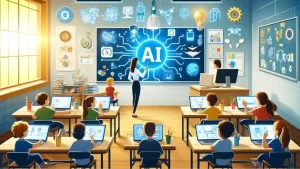
AI makes learning more easier and personal.
Online platforms recommend lessons based on each and every students performances. AI tutors answer the questions , explain concepts and help the students to learn better.
Teachers and professors also use AI to check assignments , create quizzes and track student performance.
Artificial Intelligence in Finance
Banks and financial companies use AI for daily operations.
AI helps in detecting fraud ,check financial risks improve online banking security.
It helps in making various investment decisions and analysing market trends.
Artificial Intelligence in Manufacturing
Factories and industries use AI to make the production process faster and reduce errors .
Many AI powered robots assemble products with high accuracy . It helps in predicting machine problems before failures.
It helps in checking product quality to detect defects in products before they reach customers.
Benefits of Artificial Intelligence
AI offers many benefits for individuals and in different industries.
Some major advantages include
•Improves safety
•Saves time
•Automates repetitive tasks
•Personalises recommendations
•Handles and support healthcare
It works as a smart tool. It helps to handle routine work so people can focus on meaningful tasks
Challenges and Limitations of Artificial Intelligence
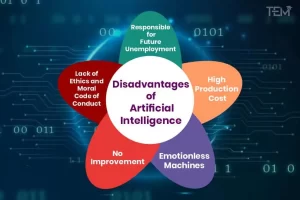
AI has many benefits , but is also has some limitations.
One of the major challenge is the data quality . It depends on good quality data so that it produce accurate results. If the data is inaccurate the results can be wrong.
The another concern is privacy. It collects large amount of personal information so organisations must protect this data responsibility.
Another major challenge is bias.If the data is based on unfair patterns it will produce unfair results.
Conclusion: The Future of Artificial Intelligence
Artificial intelligence has become a very vital part of daily life . From smartphones , online shopping,banks , schools , hospitals it helps in each and every field.
It is the process of learning from data ,recognising patterns and makes predictions to solve problem.
Today, most of the AI systems are narrow AI , designed for specific tasks. General AI and Super AI are still under research.
AI helps us to understand the technology shaping the future, if it is used ethically and responsibly , it can continue to improve our lives and create a great future.