
Keyword Research: A Step-by-Step Guide for Beginners

Have you ever wondered why some websites rank on the first page of Google while others struggle? The reason is Keyword research.
Keyword research is the most important part of an SEO strategy. It helps you understand what your audience is searching for and the type of content they expect to find. Moreover, whether you are a beginner, blogger, business owner, or digital marketer, keyword research helps you rank higher on Google. In this complete guide, you will learn everything about keyword research. We also cover the search intent, keyword types, competitor analysis, AI-powered research, and all the best tools to help you find valuable keyword opportunities. You can easily learn keyword research step-by-step with this beginner-friendly guide.
What is Keyword research?
Keyword research is the words and phrases that you can search for to gain information about your products and services on the Google search engine.
For example, someone learning about SEO might search for:
- Keyword research for beginners
- Free keyword research tools
- Best keyword search guide
- How to do keyword research
This type of searches called keywords. By understanding these keyword searches, you can create your content for peoples what they were looking for. This makes it easy for search engines to understand your content.
Why keyword research matters for SEO?
Many content writers think that writing fantastic content alone is enough to rank on Google. While high-quality content needs to match what people are searching for.
Keyword research helps you:
- Find the topics your audience is interested in.
- Understand the purpose of every search.
- Create the best content in which all the answers of user questions.
- Improve your mistakes to rank higher on the search results.
- Attract more people who are more likely to engage with your website.
Google’s goal is to provide the best results for every search. By researching keywords first, you can create the best content that aligns with user intent and delivers value. You can write the content that people actively search for.
Benefits of keyword Research

Keyword research is one of the most important steps to building a successful website.
Here are some benefits of keyword research:
Find what your audience is searching for
Keyword research helps us to find the answers to the questions of your audience.
Increase Organic traffic
Targeting some good keywords can bring more visitors to your website and increase the organic traffic.
Create Better Content
You can write better content to attract your audience. Knowing what people want allows you to write useful articles that solve the problems of the audience.
Understand search Intent
Keyword research helps you to identify the different types of intentions and create the right type of content.
Build long-term SEO Growth.
You will write the best content in which people attracting for months or even years, making keyword research a valuable long-term investment.
Why Keyword Research Is Important?
Improve Organic Search Rankings
Every day, millions of searches are made on Google. Without keyword research, it is difficult to know which topic audience are care about or how competitive they are. When you can choose the keyword that will match your audience’s needs. Then you write the helpful content for your audience and increase your chances of ranking first on Google search results. Google considers many factors when ranking pages, including relevance, quality, and how well your content satisfies the user’s search intent. Keyword research helps you to improve your search ranking from the start.
Increase Qualified Website Traffic
Keyword research helps you to attract more audience to your website and qualify the traffic on your website. For example, if you have your own digital marketing agency, ranking for “SEO service for small business” is likely to bring more relevant visitors than ranking for a broad keyword like “marketing.”
Visitors are more likely to:
- Read your content
- Contact your business
- Make a purchase
- Share your content with others
This is why keyword research is not just about increasing traffic- it is about attracting the right audience.
Types of Keywords in Keyword Research
All the keywords do not work in the same way. Some keywords help you to reach people who are looking for information, while others attract users who are ready to buy. Understanding the different types of keywords, you can create content that people are searching for. This is also improving your chances of ranking higher on the search results. You can learn keyword research step-by-step with this beginner-friendly guide.
There are types of keywords:
Short-Tail keywords
Short tail keywords usually contain one or two words. These are the broad search terms. This type of keyword has high search volume but is very competitive. Since they are broad, it is difficult to understand what the user wants.
Examples:
- SEO
- PPC
- Digital marketing
- Running shoes
Long-Tail Keyword
Long tail keywords contain three to six words. Usually, they have lower search volume, and they attract people with a clear goal. These types of keywords often have less competition and can lead to higher conversion rates.
Examples:
- Best digital marketing courses
- Best Puma shoes for men
- Digital marketing courses in Chandigarh
Informational keywords
Informational keywords help you to gain information about something and find the answers to users’ questions.
Examples:
- What is digital marketing?
- How does SEO work?
Commercial Keywords
This Keyword is used to compare the products and services before the user makes a decision. People are interested, but still they are researching more and comparing the results and then take decision.
Examples:
- Top digital marketing agencies in Chandigarh
- Best keywords Research tools
Transactional keywords
Transactional keywords are used to show the action of the user. Such as user buying a product, connecting to a business, signing up, learning more, enrolling now, etc. These keywords are ideal for product pages, service pages, and landing pages, because they often lead to conversions.
Examples:
- Enroll in a digital marketing course
- Hire an SEO expert
Branded Keywords
In these keyword searches, include the name of the company, website, or products. People search for the branded keywords who already know about the brand. Branded keywords have a higher conversion rate because the user already knows about the brand name and trusts the brand.
Examples:
- Puma running shoes for men
- Semrush keyword research
- Google keyword planner
Non-branded keywords
These keywords do not mention any specific brand. Users are looking for general information or solutions and are always open to finding different options. Non-branded keywords are very useful for attracting new visitors who do not know about your business yet. You can increase your website’s visibility and reach a wider audience.
Examples:
- Free digital marketing courses
- Best keyword research tools
- SEO software
How to do keyword research: Step by Step
Define your target audience
The first step is defining the target audience. Firstly, you can think about your visitor and the questions they might ask online. Secondly, you can consider the age, profession, location, and the problems they want to solve. For example: if you have your own digital marketing institute, your audience is students, work professional, business owners, and others who are looking to learn new skills. Then you can easily find your keywords.
Seed Keywords
Seed keywords are the words or phrases. They are related to your topic or business. Seed keyword is the first step of keyword research. For example, if your website is about SEO, your seed keyword is:
- SEO
- On-page SEO
- Off-page SEO
- SEO tools
Expand keywords using SEO tools
Once you have the seed keyword, you can use the keyword research tools to find more keyword ideas. These tools help you to show the people related searches. Long-tail keywords are less competitive and can attract more visitors who are ready to take action. Here are some examples of keyword research tools:
- Google Keyword Planner
- Google search Suggestions
- Google Trends
- Semrush
Analyze Search Volume and Difficulty
Not every keyword is good. Before choosing the keyword, you can check two important factors:
Search Volume: Firstly, you can check the Search volume. It tells you how many people search for a keyword each month.
Keyword Difficulty: Secondly, you may check the keyword difficulty. It shows how difficult to rank higher on search results.
If your website is new, you have the good strategy is to look for keywords with decent search volume and low to medium competition. This helps you have a better chance of ranking higher on search results.
Check Search intent before choosing Keywords.
Search intent is the most important part of keyword research. It tells you about why people are searching for a particular keyword. You must remember this specific thing that your content matches the user’s intent. If someone is searching for” best keyword research tools”, you may know that users expect a comparison, not a definition of keyword research. Here , you will learn keyword research step-by-step with this beginner-friendly guide.
The four main types of search intent are:
- Informational: The user wants information about something.
- Navigational: The user is looking for a website or brand.
- Commercial: The user wants to compare the options before they take any action.
- Transactional: The user is ready to take action. They buy something, sign up, enroll now, learn more, etc.
Select the best keyword for your content.
This is the last step, after comparing all the data of keywords, you choose the best keyword for your content and business goal. You can remember the one thing that you have to avoid: stuffing the same keywords throughout your content. The more natural is you content search engine is, the easier it is for it to be understood. A good content strategy usually includes:
- One Primary keyword is the main focus of your page.
- Several Secondary keywords that support the main topic.
- Related long-tail keywords to cover specific questions.
Best Keyword Research Tools
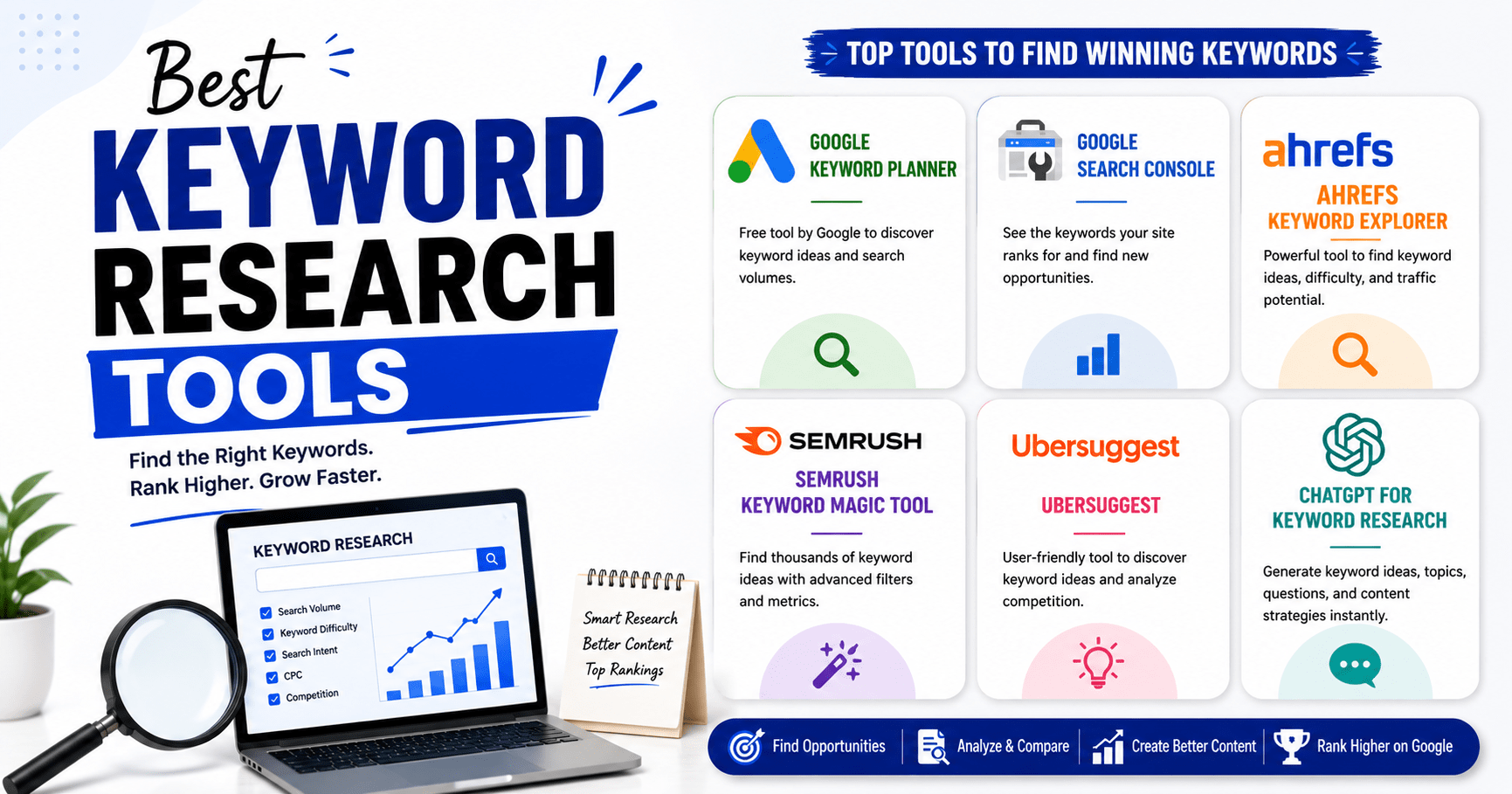
You can find the right keywords more easily when you use the right tools. Some tools are free while another offers the advanced features. The best choice depends on your budget, goals, and experience. Here are some examples of the best keyword research tools that you can use.
Google Keyword Planner
Google Keyword Planner is a free keyword research tool. It helps you to discover popular keyword ideas and estimate the monthly search volume. Google Ads designed the keyword planner, but it is also useful for SEO research. This is the right way for beginners, because the data comes directly from Google. Learn about keyword research step-by-step.
With this tool, you can:
- Find new keyword ideas.
- Check average monthly searches.
- View keyword competition.
- Discover related search terms.
Google Search Console
Google Search Console helps you understand how your website is performing on Google search. It suggests the new keywords and shows the keywords people are using to find your website.
With the help of this tool, you can:
- See which keyword brings traffic.
- Find the pages that need SEO improvements.
- Discover keyword opportunities where you rank higher on the first page.
Semrush Keyword Tool
Semrush is one of the most popular tools to find the best keywords. It has a huge database to give to the users, and it offers useful filters to narrow down your search. This tool is especially essential for a Website or blog.
It helps you to:
- Find related keywords and long tail keywords.
- Analyze keyword difficulty
- Find Search volume.
- Identify the keywords your competitors are targeting.
Chat GPT for Keyword Research
Chat GPT speeds up the keyword research by helping your ideas and ready your content strategy. It does not provide any search volume or keyword difficulty. For better results, you can use Chat GPT alongside tools like Google Keyword Planner, Google Search Console, or Semrush, etc. Chat GPT only helps you on one condition: that is, your ideas and content planning. SEO tools provide the real search data to you that you need.
Here you will learn keyword research step-by-step with this beginner-friendly guide.
You can use ChatGPT to:
- Generate seed keyword ideas.
- Find long-tail keywords.
- Group keywords by search intent.
- Build SEO-friendly content outlines.
Frequently Asked Questions
Q.1What is the best keyword research tool?
Q.1What is the best keyword research tool?