How to score 95% above in CBSE CLASS 10 BOARD EXAMS 2026
How to score 95% in CBSE CLASS 10 BOARD EXAMS
A COMPLETE GUIDE TO SCORE 95% ABOVE IN CBSE CLASS 10 BOARD EXAMS
Score 95% above in your CBSE CLASS 10 BOARD exams with ease and confidence with this complete guide. To score well in CBSE CLASS 10 board exams is an ambitious goal, and with the right strategies, study methods, guidance, and time-management techniques, it can be possible to crack 95%+ in CBSE CLASS 10 BOARD EXAMS 2026.
Why 95% is not just a dream?
Scoring 95% in CBSE class 10 board exams might sound like a tedious and very difficult task but it’s achievable. With the right strategies, consistency, and will, one can achieve this goal.
A lot of resources are available, and moreover, the exam pattern is easily predictable due to a large amount of sample papers and other information present on the internet. Many students achieve these desired goals, so if they can do it, you can too. But remember, concept clarity and consistency are the key.

Understanding CBSE Class 10 BOARD EXAMS pattern 2026:
To understand the pattern, analysis of format, marking scheme and internal assesment marks distribution is vital.
- Format of the question paper
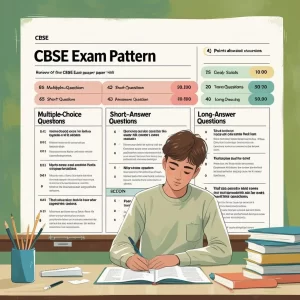
CBSE board exam format can be predicted by using previous year question papers. Typically, the paper includes questions like:
- MCQ type {multiple choice questions}
- Very short answer-type questions {1-mark answers} Additionally, short-answer-type questions include responses like one-line definitions.
- Short answer type questions {2-3 marks}—these include short answers, which generally consist of 30-50 words.
- Long answer type questions {5-6 marks}—these include answers consisting of 100-150 words each.
- Case-based questions—Moreover, case-based questions consist of real-life scenarios usually including sub-questions like MCQs and one-liners.
- Competency-based questions {newly included}—these include application-based questions, which test your ability to apply concepts in daily life.
As they are recently included in the exam format, one must pay good attention to this to increase their chances of scoring good!
- Marking Scheme
Marking scheme helps us to know how much weightage does theory and practical exams hold.
- Total marks= 100
- 80 marks for theory paper
- 20 marks for practical exam, internal assessment, project work or anything specified by your school.
- Internal assessment
This includes unit tests, submissions done to your teachers, subject-enrichment activities.
Don’t ignore these things to ensure an edge over others
How to prepare smartly for CBSE Class 10 BOARD EXAMS:
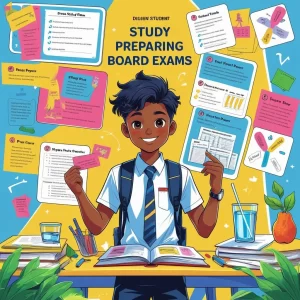
- Practice sample papers- Practicing sample papers help you adapt according to the paper set by CBSE and helps you understand the pattern. It is recommended to solve at least 10 sample papers of each subject to gain confidence and smoothness while attempting your final exam.
You can refer to the official CBSE site for sample papers as well as other sites like Byjus or books like OSWAL, Educart and more.
2. Prioritize NCERT books
– Thoroughly go through NCERT books for all subjects and revise them multiple times as these are the foundation of CBSE exams.
NCERT exemplar is a great book to refer to questions for practice and better understanding and they are generally seen in exam papers.
Solve in-text and back exercises at least twice.
- Revision – Daily revision and consistency will play a crucial role and will be a game changer to score good marks in exams.
- Make a realistic study plan- Download the whole syllabus from CBSE’s official website and mark the most important chapters that hold maximum weightage.
Break the total syllabus into parts and assign topics to yourself daily and study in short focused sessions {like 1 or 2 hours on each subject}.
Study techniques like POMODORO technique which provides a balance between study sessions and breaks to ensure maximum productivity and will help you get better results in CBSE board exams 2026.

- Make one-page notes- One-page notes are notes that summarize the entire chapter or topic in one page including all the important concepts and formulae which helps us to go through the topics many times in less time.
- Use mind maps or visual aids- Make flowcharts, diagrams and maps especially useful for science and SST.
- Revise smartly- Use the 3x revision rule to retain maximum information:
- First revision- should be done within 2 weeks of learning
- Second revision- should be done 1 month before exam
- Final revision- should be done 7-10 days before board exam.
Importance of staying healthy {both mentally and physically}:
A healthy mind and body lead to proper brain function. Thus it is important take care of your health both mentally and physically to ensure proper and a calm state of mind. Neglecting your health uncompromising under all circumstances.

How to take care of your health while preparing for board exams:
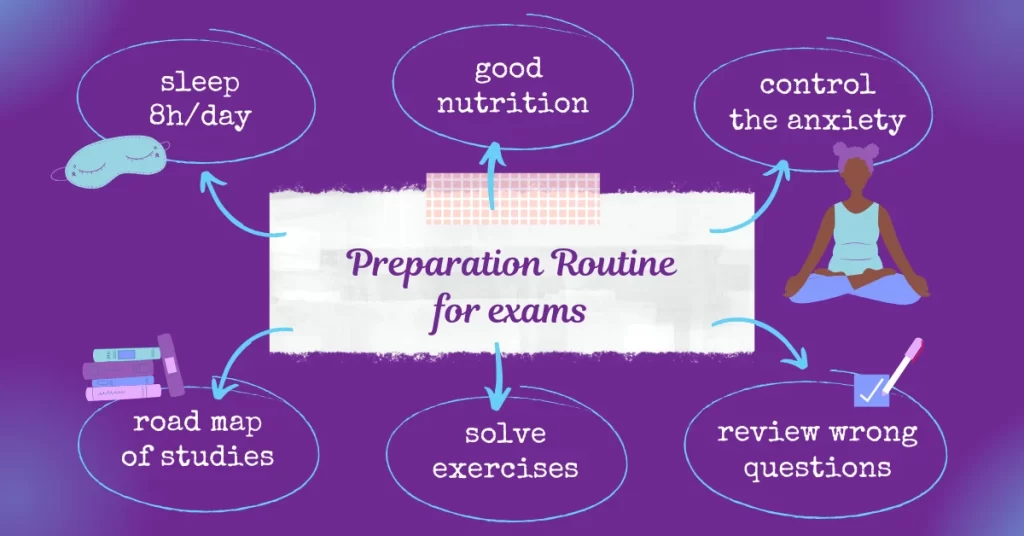
1.Eat nutritious foods
What to eat?
Green veggies, nuts like almonds, walnuts, fruits, eggs and to avoid junk food, excess caffeine, fried snacks and more
2.Stay hydrated
To begin with, drinking at least 6-8 glasses of water daily is essential to prevent fatigue and poor concentration that may occur due to dehydration.
3. Get enough sleep
Human body needs good 7-8 hours of sleep daily to ensure healthy brain activity. Avoid late night cramming and staying up late at night. A well-rested brain retains and performs better.
4.Exercise and keep your body active
Staying physically active is essential for your body. Doing light exercises like stretching and walking for 20-30 minutes daily helps a lot . Yoga and breathing exercises help improve mental health as well. Physical activity keeps mind fresh and boosts mood.
5.Manage stress positively
Break syllabus into manageable chunks and avoid comparing with others as everybody has their own pace and one should just stay consistent and be true to themselves.
6. Take breaks and relax
Healthy breaks are essential to keep mind fresh and avoid saturation of brain. Use techniques like POMODORO TECHNIQUE.
Subject-wise preparation ideas for CBSE BOARD EXAMS :
Science {Class 10}/ Physics, Chemistry, Biology {class12}
Highlight important and difficult topics and focus on numericals, formulas, reactions, periodic trends, diagrams, definitions and one-word answers.
Learn all NCERT diagrams and experiments and solve PYQs {previous year questions}
Mathematics
Focus on important topics and keep practicing many times.
For class 10 – Triangles, AP, Quadratic equations and Statistics
For class 12- Calculus, Relations and functions, Probability are important and must be paid attention to.
It is advisable to practice and cover all questions and exercises given in NCERT books.
English
Focus on reading comprehension, letter article writing, literature.
Practice reading unseen passages and make notes of author names and summaries of chapters.
Social Science
- History- Focus on dates, events, timelines, causes and effects
- Geography- Focus on map work, definitions, minerals and agriculture.
- Civics- Focus on political terms and functions of institutions
- Economics- Focus on understanding diagrams and graphs and key terms and definitions.
Stick to NCERT- based answers
Importantly, focus on NCERT as majority of the CBSE board exam paper comes from NCERT and its exemplar only.
In addition, revising as many times as you can and taking care of your health and STAY CONSISTENT are the most important tips for preparation.
Finally, Good luck to you and enjoy the journey and make most of it !